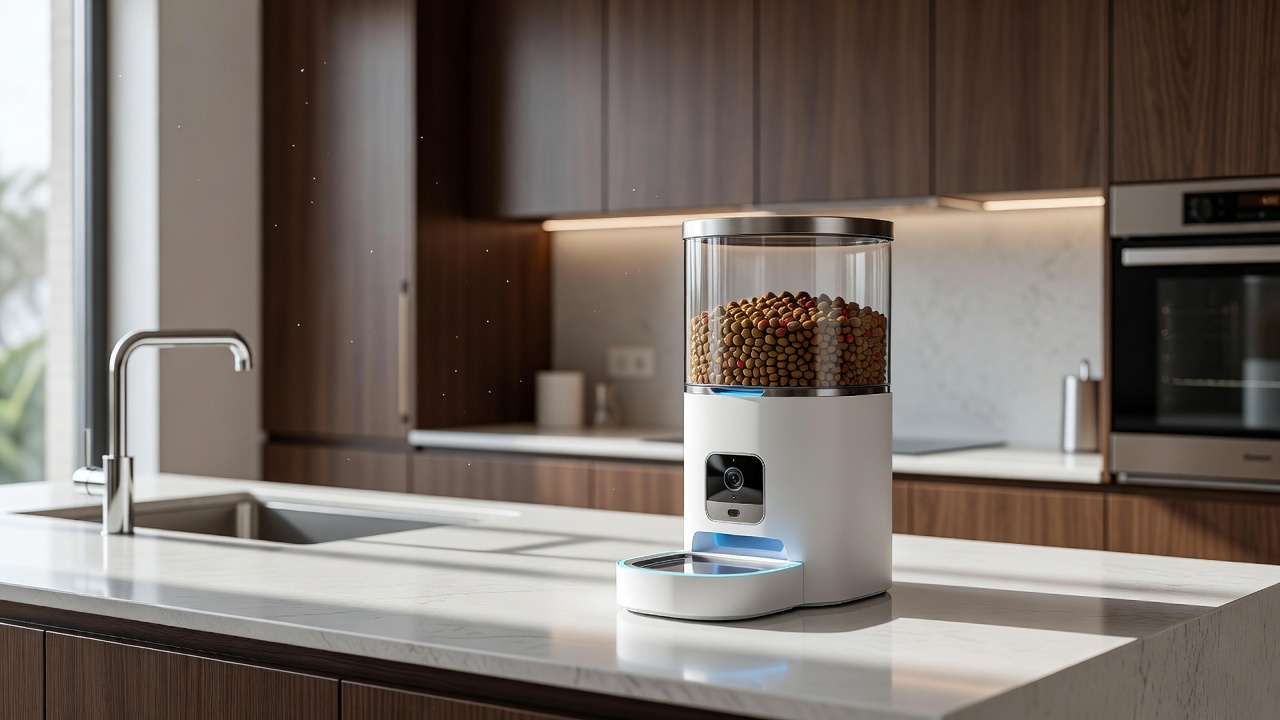
The Spectrum of Feeder Types
Not all feeders are electronic. The market broadly divides into three distinct categories based on their functional mechanisms.
1. Gravity Feeders
The simplest design relies entirely on physics. As the pet eats from the bowl, food drops from a hopper above to refill it. They require no electricity or batteries.
- Pros: Zero chance of mechanical failure, inexpensive, holds large volumes of food.
- Cons: Cannot restrict portion sizes. This setup leads directly to overeating and obesity in highly food-motivated pets.
- Best For: Self-regulating pets, outdoor barn cats, or strictly for water (gravity waterers are excellent).
2. Programmable Portion-Control Feeders
These electronic units utilize a motorized rotor at the base of a food hopper. You program the unit to dispense a specific number of "portions" at exact times of day. Most use an LCD screen and buttons on the unit itself.
- Pros: Excellent for dietary management and weight loss plans. Reliable scheduling.
- Cons: Programming interfaces can be notoriously difficult to navigate (often requiring complex button combinations).
3. Smart Wi-Fi Feeders
Building on the programmable framework, smart feeders connect to your home network, allowing you to control schedules, portion sizes, and trigger manual feedings via a smartphone app.
- Pros: Highly convenient. Often includes notifications (e.g., "Food dispensed successfully," "Hopper empty").
- Cons: Higher price point. Dependent on home Wi-Fi stability; if the router drops, some models lose their schedule.
Key Mechanisms to Evaluate
When investing in an automatic feeder, the electronics are secondary to the physical engineering. A smart feeder is useless if it jams.
Anti-Jam Technology
Kibble is not uniform. Shapes vary (triangles, stars, spheres) and sizes range from tiny kitten pellets to large breed chunks. Look for feeders that explicitly detail their anti-jamming mechanisms. The best units feature soft, flexible silicone rotors rather than hard plastic ones. If a piece of kibble gets caught, the silicone gives way, or the motor senses the resistance and momentarily reverses direction to clear the block.
Kibble Size Compatibility
Always check the manufacturer's maximum kibble size rating (usually expressed in millimeters, e.g., 5mm–15mm). If you feed a large-breed dog diet or freeze-dried raw chunks, a standard cat/small dog feeder will jam repeatedly.
Power Fail-Safes
A feeder that relies solely on a wall plug is a vulnerability. In a power outage, your pet misses meals. High-quality electronic feeders utilize a dual power supply: an AC adapter for primary power, supplemented by D-cell or C-cell batteries as an emergency backup. Ensure the unit retains its internal clock and schedule during a power transition.
What About Wet Food?
Hopper-style dispensers only work for dry kibble. For wet or raw diets, you must look to Carousel (Rotary) Feeders. These units feature a flat disk segmented into 4 to 6 compartments, covered by a lid with a single opening. At scheduled times, the disk rotates one slot to expose the next meal.
Because wet food spoils at room temperature, look for rotary feeders that include a hollow base for reusable ice packs. This keeps the food safely chilled for 24 to 48 hours. These are generally battery-operated and highly reliable, though they require daily washing and refilling compared to a dry food hopper.